
Private Credit and the AI Infrastructure Boom


Private Credit and the AI Infrastructure Boom
A new risk lens for an opaque credit system
Author: Cristina Has, Chief Product Officer, Razor Risk
Lausanne, Switzerland
Introduction
Artificial intelligence is usually discussed as a technology story. The public debate focuses on model capabilities, productivity gains, semiconductor supply, cloud capacity, the competitive position of large technology companies, and – nowadays – the race to secure compute, power, and capital. Yet, beneath the visible layer of the AI boom, sits a less visible financial story: the rapid growth of infrastructure financing required to build, power, and operate the data centres on which artificial intelligence depends.
This paper argues that the AI infrastructure boom is becoming a private credit risk management issue. Private credit is not the sole financing engine of AI infrastructure. Hyperscaler cash flows, corporate bonds, bank lending, securitisation, private equity, venture capital, and sovereign capital all form part of the financing stack. However, private credit is becoming an increasingly important and relatively opaque channel through which AI infrastructure risk is being funded, distributed, and transformed.
The implication for banks, and financial institutions generally, is significant. The question is no longer simply whether an institution has a direct allocation to private credit. The more important question is whether it can see, measure, and stress the full chain of exposures created by the AI infrastructure buildout. These exposures may appear across bank credit lines, fund financing, borrower revolving facilities, private equity sponsor relationships, insurance exposures, securitised structures, collateral valuations, and off-balance-sheet commitments.
Private credit therefore needs to be understood not only as an asset class, but as part of a broader risk-transmission layer within the financial system. As the financing of AI infrastructure accelerates, risk visibility may matter more than allocation. Building on recent analysis from the BIS, FSB, Bank of England and IMF, this paper proposes a risk management framework for banks and financial institutions focused on visibility across the full private credit ecosystem (Avalos et al., 2025; Bank of England, 2025; Financial Stability Board, 2026; International Monetary Fund, 2024).
1. Looking Back | How Private Credit Became a Core Financing Channel
1.1. From Alternative Allocation to Mainstream Credit Intermediation
Private credit has grown rapidly over the past two decades. Once viewed as a specialist allocation within alternative assets, it has become a major source of financing for companies that are smaller, more leveraged, less transparent, or less well served by traditional bank lending and public debt markets. Estimates vary depending on definitions, but private credit assets under management exceed USD 2.5 trillion globally according to the Bank for International Settlements, while the Financial Stability Board estimates the market at between USD 1.5 trillion and USD 2 trillion at end-2024 (Avalos et al., 2025; Financial Stability Board, 2026).
The growth of private credit reflects both demand and supply factors. On the demand side, borrowers value flexible capital, bespoke terms, speed of execution, and willingness to finance more complex corporate structures. On the supply side, institutional investors such as pension funds, insurers, and sovereign wealth funds have sought long-dated assets, attractive yields, and illiquidity premia. Post-crisis banking regulation and changes in banks’ willingness to hold certain credit risks also created space for nonbank lenders to expand (International Monetary Fund, 2024; Avalos et al., 2025).
This shift has brought benefits. Private credit can provide financing to borrowers that may otherwise struggle to access capital. It can support long-term investment, infrastructure development, and corporate growth. Closed-ended fund structures can also reduce some forms of liquidity mismatch when compared with deposit-funded banking models.
However, the same characteristics that make private credit attractive also create risk-management challenges. Assets are illiquid, valuations are less frequent and less observable, borrower-level data is often limited, and exposures are distributed across a complex ecosystem of funds, banks, sponsors, insurers, and end-investors. Private credit is therefore not simply a substitute for bank lending. It is a different form of credit intermediation, with different visibility, governance, and stress-transmission characteristics.
1.2. The Visibility Problem Behind the Growth Story
The debate around private credit is often framed as a question of whether the asset class is safer or riskier than public credit. This is too narrow. The more important question is whether institutions can observe the risks they are taking, directly and indirectly.
Private credit exposures may not be concentrated in a single portfolio or legal entity. A bank may provide financing to a private credit fund, lend to a company backed by that fund, support a revolving credit facility for the same borrower, finance a related private equity sponsor, or participate in a securitised structure referencing similar underlying assets. An insurer may invest in private credit funds, hold rated private credit instruments, or participate in funded reinsurance structures. Asset managers may manage both private equity and private credit strategies, creating sponsor-level and borrower-level interconnections.
This creates a gap between economic exposure and reported exposure. Risks that look manageable in isolation may become correlated under stress. The Financial Stability Board has highlighted vulnerabilities around bank interlinkages, borrower credit quality, valuation practices, leverage, liquidity mismatches, concentration, and data gaps (Financial Stability Board, 2026). These are not separate issues. They are different expressions of the same problem: the financial system does not yet have a sufficiently clear map of the private credit risk chain.
2. What Changed | AI Infrastructure Deepens Private Credit’s Financial Interconnections
2.1. AI Turns Compute Demand into Credit Demand
The AI boom is transforming demand for physical infrastructure. Generative AI requires large-scale compute capacity, which in turn requires data centres, power access, cooling systems, network connectivity, specialised equipment, long-term leases, and significant upfront capital expenditure. The growth of AI is therefore not only a software or semiconductor story. It is also a real estate, energy, infrastructure, and credit story.
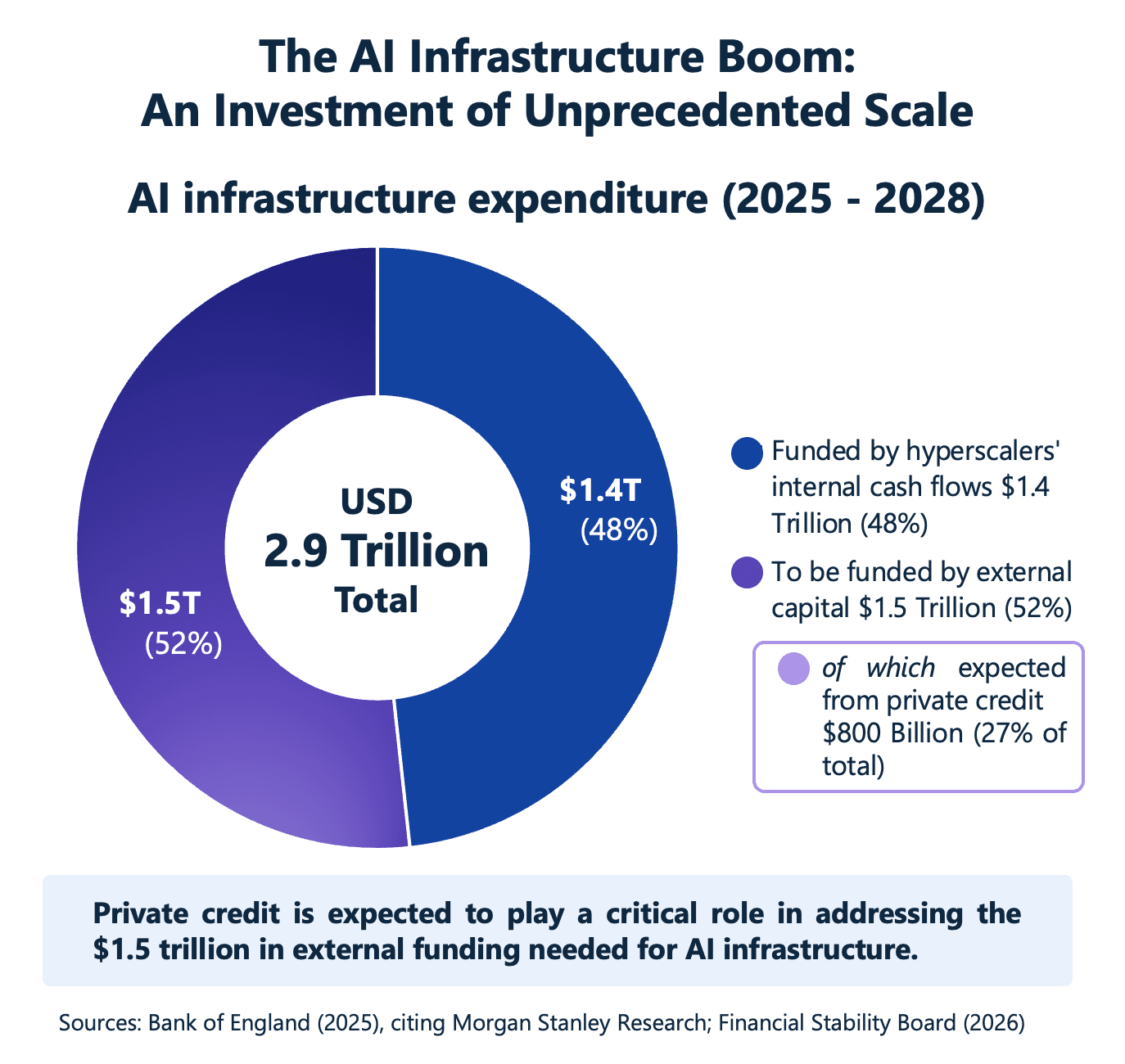
The scale of expected investment is substantial. The Bank of England cites estimates that AI infrastructure capital expenditure between 2025 and 2028 could reach USD 2.9 trillion, with USD 1.5 trillion expected to be met by external capital, including USD 800 billion from private credit (Bank of England, 2025). The Financial Stability Board similarly notes that private credit is playing a critical role in addressing the financing needs of data centre investments linked to the rapid expansion of generative AI (Financial Stability Board, 2026).
More recent developments suggest that this projected financing requirement is increasingly becoming visible in capital markets. J.P. Morgan estimates that capital expenditure by the five largest US hyperscalers will reach approximately USD 697 billion in 2026 alone (J.P. Morgan, 2026). In August 2026, NVIDIA announced partnerships with Apollo, BlackRock, Blackstone, Brookfield, Goldman Sachs and KKR to establish financing platforms designed to mobilise more than USD 500 billion of third-party capital for AI infrastructure over time (NVIDIA Corporation, 2026). The initiative is particularly significant not because all of this capital represents private credit – it does not – but because it illustrates the broader transformation taking place: compute infrastructure is increasingly being financed as an investable asset class through institutional capital, credit and structured financing channels.
This does not mean that private credit is financing the entire AI boom. Large technology companies continue to fund significant investment through internal cash flows. Public debt, asset-backed securities, commercial mortgage-backed securities, private equity, venture capital, bank lending, and sovereign capital also form part of the financing stack. However, private credit is becoming an important marginal source of financing for the next phase of AI infrastructure.
That marginal role matters. In credit markets, risk relevance can arise not from financing everything, but from financing the part of the system where visibility is lowest, leverage is layered, and assumptions are most uncertain.
2.2. The AI Infrastructure Credit Chain
The financing of AI infrastructure increasingly involves structures that sit between corporate finance, project finance, asset-backed finance, and private markets. Data centre projects may be funded through joint ventures, special-purpose vehicles, asset-backed loans, long-term lease structures, or arrangements supported by offtake agreements and guarantees. These structures can provide flexibility and capital efficiency. They can also result in economically debt-like obligations sitting outside the balance sheet of the entity from which the underlying economic demand originates.
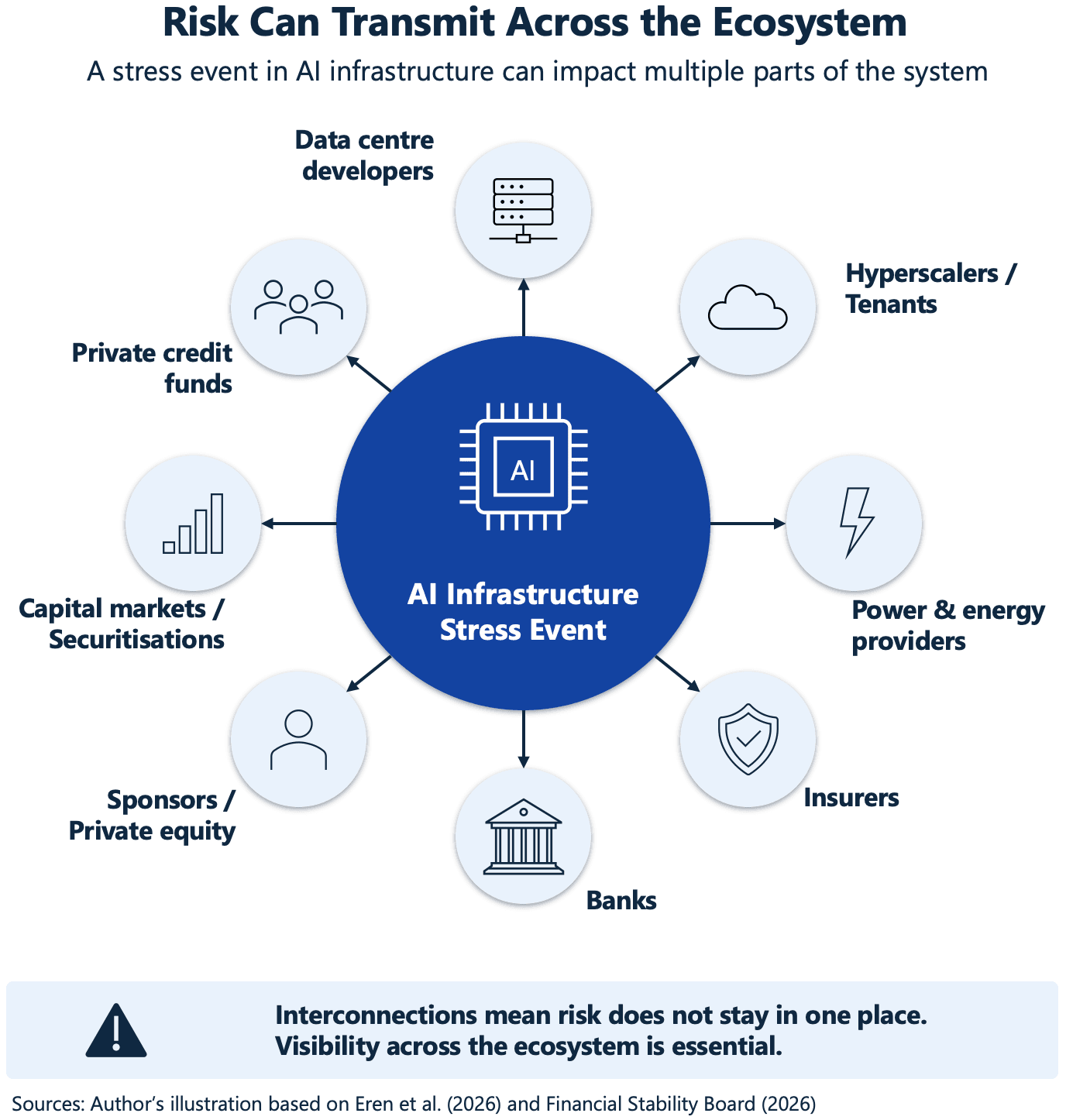
The Bank for International Settlements has described certain AI infrastructure financing arrangements as “shadow borrowing”: obligations that are economically similar to debt but largely reside outside corporate balance sheets (Eren et al., 2026). Such structures may strengthen links between hyperscalers, private credit vehicles, insurers, and banks. Banks may not own the AI infrastructure exposure directly, but they may support the ecosystem through funding lines, guarantees, revolving facilities, collateralised lending, or relationships with private credit funds and sponsors.
The result is an AI infrastructure credit chain in which economic exposure does not necessarily follow legal or accounting boundaries. The borrower may be a data centre developer, while the economic anchor is a long-term hyperscaler lease. Financing may sit within a special-purpose vehicle or private credit fund, while the ultimate capital is provided by insurers, pension funds, or other institutional investors. A bank may appear elsewhere in the chain through a fund financing line, warehouse facility, revolving credit facility, guarantee, or collateralised lending relationship. No single balance sheet therefore necessarily captures the full economic dependency.
This distinction matters for risk management. Legal entities determine where exposures are booked; economic dependencies determine how those exposures may behave under stress. Understanding the AI infrastructure credit chain therefore requires institutions to connect borrowers, sponsors, financing vehicles, lenders, guarantors, investors, tenants, and collateral across organisational and product boundaries.
In benign conditions, these structures can work efficiently. In stress, the interconnections matter. A shortfall in power availability, a delay in data centre construction, a reassessment of AI demand, a deterioration in hyperscaler credit quality, or a fall in AI-related asset valuations could affect multiple parts of the financing chain at the same time.
2.3. From Technology Concentration to Credit Concentration
AI infrastructure creates a new form of concentration risk. Traditional credit concentration is often measured by borrower, sector, geography, rating, or counterparty. AI infrastructure requires a broader lens. The relevant risk drivers include technology adoption, compute demand, electricity supply, energy prices, permitting timelines, construction risk, equipment availability, tenant concentration, lease quality, refinancing conditions, and collateral valuation.
Private credit lending to AI-related sectors has already increased significantly. The Financial Stability Board notes that AI-related sectors reached 34% of private credit deals in 2025, compared with an average of 17% over the previous five years (Financial Stability Board, 2026). This does not necessarily imply excessive risk. Specialist lenders may have strong underwriting capabilities and asset-based structures can be supported by long-term cash flows. However, specialisation becomes a vulnerability when many exposures depend on the same assumptions.
For AI infrastructure, those assumptions are unusually consequential. They include expectations about the pace of AI adoption, the economics of inference, the durability of demand for compute, the availability of power, the creditworthiness of tenants, and the residual value of highly specialised assets. If these assumptions change, risks that appear diversified across borrowers or vehicles may behave as one correlated exposure.
There is, however, another dimension to this concentration risk. Private credit is exposed to AI not only through the infrastructure required to support its growth, but also through lending to businesses whose economics AI itself may disrupt. Recent BIS analysis shows that US business development companies have approximately USD 115 billion of lending to software firms, representing around one fifth of their total lending and more than 80% of their technology portfolios. The same analysis finds that the revenue uncertainty created by generative AI has not yet resulted in materially different loan pricing for software exposure (Avalos et al., 2026).
This creates a two-sided AI exposure for private credit. On one side, private capital is financing the data centres, power, equipment, and other infrastructure required for AI to expand. On the other, private credit is lending to companies whose business models, revenues, or competitive positions may themselves be affected by that expansion. AI can therefore act simultaneously as a driver of credit creation and as a source of credit disruption.
For risk managers, this changes the concentration question. Institutions should not only ask how much exposure they have to AI infrastructure. They should ask where AI acts as a common economic risk driver across both growth exposures and disruption exposures – and whether portfolios that appear diversified by borrower or sector may ultimately depend on the same technological transition.
3. The Risk Gap | Why Allocation Is No Longer Enough
3.1. Direct Exposure Is Only the Starting Point
For banks and financial institutions, the first instinct is to ask: What is our direct exposure to private credit? This is necessary, but insufficient.
A direct exposure view captures holdings, loans, or investments that are explicitly booked as private credit-related. It may not capture second-order exposures. These include bank lending to private credit funds, financing to private equity sponsors, revolving credit facilities to companies financed by private credit, synthetic risk transfer structures, credit insurance, collateralised lending, warehouse lines, or exposure to insurers and pension funds with private credit allocations.
The result is a risk management blind spot. Institutions may underestimate their sensitivity to private credit stress because they measure exposures by product category rather than by economic dependency. A bank may report limited private credit exposure while still being exposed to the same borrower, sponsor, sector, collateral type, or financing structure through multiple channels.
The AI infrastructure boom intensifies this issue because the underlying credit drivers cut across sectors. A data centre exposure may appear as real estate finance, infrastructure credit, technology lending, power-related exposure, asset-backed finance, fund finance, or corporate credit. Without consistent tagging, aggregation, and scenario analysis, institutions may fail to identify the common risk factor: dependence on AI infrastructure economics.
3.2. Valuation Risk Becomes Governance Risk
Private credit valuation is inherently more complex than valuation in liquid public markets. Loans are bespoke, trading is limited, market prices are often unavailable, and valuation models rely on assumptions about credit quality, spreads, collateral values, borrower performance, and comparable market indicators. In normal conditions, these assumptions may appear stable. In stress, they may be challenged simultaneously.
The risk is not only that valuations may decline. The deeper issue is that delayed recognition of losses can weaken confidence. If investors, lenders, and regulators cannot agree on whether credit deterioration has been recognised appropriately, valuation risk becomes governance risk. Disputes over valuation can create redemption pressure, reduce market confidence, and complicate funding decisions.
For AI infrastructure, valuation risk is amplified by uncertainty around the long-term economics of the assets. Data centres may be supported by long-term leases, but their value depends on power availability, tenant quality, construction delivery, technological relevance, and expectations for future compute demand. A reassessment of AI-related growth assumptions could affect both the equity valuations of technology firms and the credit valuations of infrastructure vehicles connected to them.
3.3. Liquidity Risk Moves Through the Ecosystem
Private credit is often defended on the basis that many funds are closed-ended and therefore less vulnerable to runs than open-ended vehicles. This is partly true. However, liquidity risk does not disappear; it changes location.
Liquidity pressure can arise through redemption - enabled private credit vehicles, investor capital calls, bank credit lines, borrower revolver drawdowns, refinancing needs, collateral margining, or forced sales of more liquid assets by institutions that need to meet obligations elsewhere. The Financial Stability Board has noted that the growth of semi-liquid and redemption-enabled private credit structures may increase liquidity mismatch vulnerabilities (Financial Stability Board, 2026).
In an AI infrastructure stress scenario, liquidity pressure could move through several channels at once. A decline in AI-related valuations could reduce investor confidence. Data centre delays could pressure borrowers. Refinancing costs could rise. Private credit vehicles could draw bank lines. Investors with exposure to both private credit and public markets could sell liquid assets to meet private market obligations. Banks could face pressure not through a single large exposure, but through multiple smaller exposures becoming correlated.
This is why the risk-management challenge is not only credit loss estimation. It is the ability to understand how credit, liquidity, market, and counterparty risk interact under stress.
4. Looking Ahead | The CLEAR Framework for Private Credit Risk Visibility
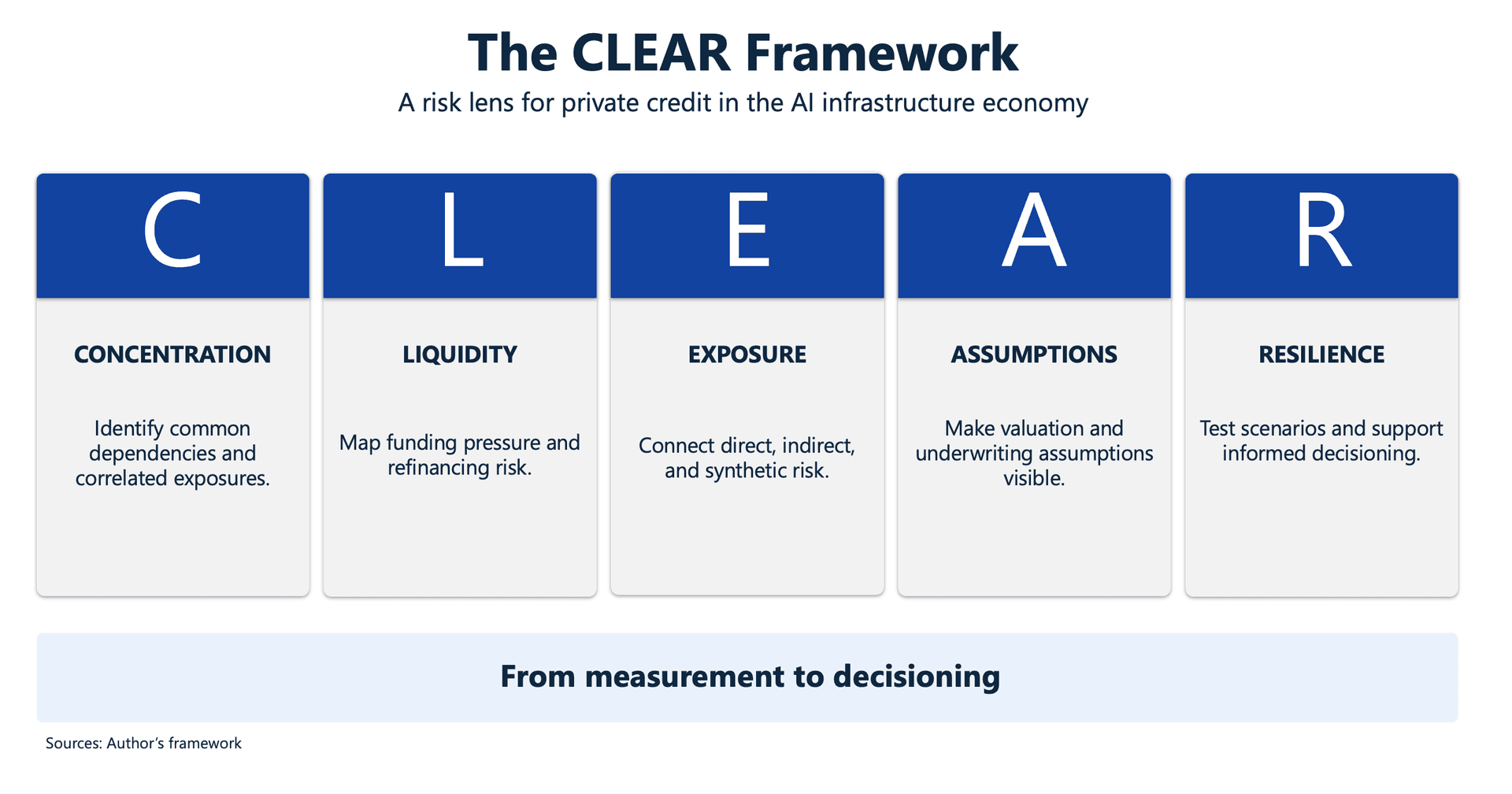
To address the emerging risk-management challenge, this paper proposes the CLEAR Framework: Concentration, Liquidity, Exposure, Assumptions, and Resilience. The framework is designed to shift the discussion from static allocation to dynamic risk visibility.
4.1. Concentration: Identifying Common Dependencies
Concentration should be measured beyond traditional borrower and sector classifications. In AI infrastructure, relevant concentration dimensions include hyperscaler tenant exposure, data centre operator exposure, geography, power grid dependency, sponsor concentration, private credit manager concentration, bank financing concentration, technology dependency, and collateral type.
The key question is not simply: How much exposure do we have to private credit? It is: Which exposures depend on the same economic assumptions?
A CLEAR concentration view would identify common dependencies across business lines and portfolios. For example, a bank may have exposures to several different funds, borrowers, or financing vehicles that all depend on the same hyperscaler, the same power-constrained region, or the same assumption about continued growth in AI compute demand. Without this aggregation, apparent diversification may conceal economic concentration.
4.2. Liquidity: Mapping Funding Pressure Before It Appears
Liquidity analysis should include both contractual liquidity and behavioural liquidity. Contractual liquidity captures maturity dates, redemption windows, covenants, collateral requirements, and committed facilities. Behavioural liquidity captures how borrowers, investors, funds, and banks are likely to act under stress.
In private credit, liquidity pressures may be delayed rather than immediate. This can create a false sense of stability. A loan may not be marked down quickly, a fund may not face daily withdrawals, and a borrower may not default immediately. But liquidity pressure can accumulate through refinancing walls, delayed construction milestones, revolver drawdowns, or investor redemption requests.
For AI infrastructure, liquidity analysis should consider power delays, construction overruns, utilisation shortfalls, tenant renegotiation risk, and refinancing costs. The objective is to identify where a stress could create liquidity demand before accounting losses become visible.
4.3. Exposure: Connecting Direct, Indirect, and Synthetic Risk
Exposure management must move from product-level classification to economic linkage. A financial institution should be able to connect direct holdings, bank facilities, sponsor relationships, fund financing, credit insurance, securitised exposures, collateralised loans, and off-balance-sheet commitments.
This requires consistent identifiers, data reconciliation, and exposure mapping. Borrowers, sponsors, funds, vehicles, counterparties, collateral pools, and guarantors need to be linked across systems. Without this, institutions may miss the fact that separate exposures are connected to the same risk event.
For banks, this is particularly important because private credit risk may enter the balance sheet through indirect channels. The exposure may not be labelled “private credit,” but the economic dependency may still be private credit-related. Risk systems therefore need to recognise the ecosystem, not only the accounting category.
4.4. Assumptions: Making the Invisible Model Visible
Every private credit exposure depends on assumptions. In AI infrastructure, these assumptions may include compute demand, power availability, tenant quality, construction cost, utilisation rate, lease enforceability, refinancing spread, collateral value, and technological obsolescence. These assumptions are often embedded in underwriting models, valuation processes, credit memos, and fund reporting.
The CLEAR Framework treats assumptions as first-class risk data. Institutions should be able to identify which assumptions drive valuation and credit quality, where those assumptions are shared across exposures, and how sensitive portfolios are to changes in them.
This is especially important for AI infrastructure because the market is still forming. Historical data may be limited. Demand projections may be uncertain. Technology cycles may be shorter than financing maturities. The quality of risk management will therefore depend not only on data availability, but on assumption transparency.
4.5. Resilience: From Static Reporting to Scenario-Based Risk Management
Resilience is the ability to absorb stress without losing control of the risk picture. It requires scenario analysis, reverse stress testing, governance, and timely decision-making.
For AI-linked private credit, the most informative scenarios may increasingly be compound rather than single-factor stresses. An energy-price shock or power shortage may coincide with higher-for-longer interest rates; trade restrictions or supply-chain disruption may delay equipment delivery while increasing construction costs; or an AI-related valuation correction may occur at the same time as refinancing spreads widen and liquidity conditions deteriorate. Such combinations are particularly relevant in an interconnected credit system because a shock originating in one risk category may transmit through several others. Recent BIS analysis similarly highlights the potential interaction between AI-related repricing, tighter financial conditions, private credit vulnerabilities, and liquidity pressure in direct-lending funds (Bank for International Settlements, 2026).
The purpose of these scenarios is not to predict the future. It is to reveal hidden dependencies. A good scenario should show which exposures become correlated, which liquidity needs appear first, which assumptions break, and which decision-makers need to act.
This is where risk infrastructure becomes critical. Static reports are not sufficient for a dynamic, interconnected credit ecosystem. Institutions need the ability to aggregate exposures, run what-if analysis, reconcile data, test assumptions, and produce explainable outputs across credit, market, liquidity, and counterparty risk. In this environment, risk technology is not only a reporting tool. It becomes an operating layer for financial resilience.
5. Implications for Banks and Risk Leaders
5.1. The Question Is Not Allocation, but Observability
The traditional investment question is: How much private credit exposure should we hold? The emerging risk-management question is: How observable is our private credit exposure, including indirect and second-order channels?
This shift matters because the AI infrastructure boom is creating exposures that may not fit neatly into existing risk categories. A bank may classify one exposure as fund finance, another as corporate credit, another as infrastructure finance, and another as counterparty risk. Yet all may depend on the same data centre economics. Risk leaders therefore need a cross-product view that connects exposures by economic dependency.
5.2. Data Quality Becomes a Strategic Control
Data gaps are one of the most important vulnerabilities in private credit. Without granular borrower-level, fund-level, and exposure-level data, institutions cannot reliably assess concentration, valuation, liquidity, or interconnectedness. Data quality is therefore not a back-office issue. It is a strategic control.
For AI infrastructure, this means capturing not only financial data, but also operational and contractual risk drivers: tenant concentration, lease duration, power availability, construction milestones, collateral type, sponsor support, financing maturity, and refinancing assumptions. These data points need to be connected to credit, liquidity, and market risk systems.
5.3. Governance Must Match the Complexity of the Ecosystem
Private credit governance cannot remain limited to investment approval and periodic valuation review. Governance needs to reflect the complexity of the ecosystem. This includes clear ownership of assumptions, escalation processes for valuation uncertainty, stress-testing governance, data lineage, and cross-functional review between credit, treasury, market risk, liquidity risk, finance, and front-office teams.
For banks, this is especially important because exposures may sit across multiple business lines. No single desk may see the full picture. Governance should therefore ensure that risk aggregation happens at the level where the economic exposure exists, not only where individual transactions are booked.
5.4. Risk Technology Moves from Measurement to Decisioning
The next phase of private credit risk management will require more than periodic reporting and exposure calculation. Institutions will need to move from measurement to decisioning: from knowing what their exposures are, to understanding what those exposures mean, how they may evolve, and which actions are available under different scenarios.
This shift is particularly important in private credit because the risk picture is fragmented by nature. Relevant information may sit across borrower financials, fund reports, collateral data, sponsor relationships, bank facilities, insurance exposures, valuation assumptions, market indicators, and unstructured documents. Traditional risk systems are often designed to measure defined exposures within established categories. The emerging challenge is different: institutions need to connect large and heterogeneous datasets, identify hidden dependencies, and translate analysis into timely, explainable decision options.
Artificial intelligence can play an important role in this transition when it is applied with appropriate context and control (as argued in our earlier paper on achieving AI ROI through value co-creation; Has, 2026). AI can help analyse large volumes of structured and unstructured data, detect patterns across portfolios, surface inconsistencies, and support grounded reasoning based on institution-specific data, assumptions, and policies. It can also help risk teams generate and compare scenarios, ask better what-if questions, and understand which risk drivers are most material under changing conditions.
The objective is not to automate credit judgement or replace expert accountability. In regulated financial institutions, decisions must remain explainable, governed, and owned by the appropriate business and risk functions. The value of AI-enabled risk technology lies in augmenting decision-making: presenting relevant evidence, highlighting trade-offs, identifying vulnerable exposures, and helping decision-makers compare options before stress materialises.
This is highly relevant for banks, central counterparties, treasury managers, broker / dealers, and other financial institutions that need to manage credit, market, liquidity, and counterparty risks in an increasingly interconnected environment. As private credit becomes more connected to strategic sectors such as AI infrastructure, the differentiator will not be the ability to produce another static report. It will be the ability to reconcile data, run timely what-if analysis, generate plausible stress scenarios, explain the drivers of risk, and support informed decisions across the full private credit ecosystem.
In this environment, risk technology becomes more than a measurement layer. It becomes a decisioning layer: a bridge between data, scenarios, expert judgement, and management action.
Conclusion
The AI infrastructure boom is creating a new financing challenge. Behind the visible race to build models, chips, and cloud platforms sits a capital-intensive infrastructure buildout that requires data centres, power, equipment, and long-term financing. Private credit is not the only source of this financing, but it is becoming an increasingly important and relatively opaque channel through which AI infrastructure risk is distributed.
This creates a new risk management problem for banks and financial institutions. The issue is not simply whether they are invested in private credit funds. The issue is whether they can see the full chain of exposures created by private credit’s role in the AI infrastructure economy. Those exposures may be direct, indirect, synthetic, off-balance-sheet, or embedded in relationships with borrowers, funds, sponsors, insurers, and other financial intermediaries.
The CLEAR Framework – Concentration, Liquidity, Exposure, Assumptions, and Resilience – provides a practical lens for managing this challenge. It shifts the focus from allocation to observability, from static reporting to scenario-based management, and from product-level classification to economic risk linkage.
In the next phase of the cycle, the winners will not be the institutions that simply increase or decrease private credit exposure. The winners will be those that understand where private credit sits in the broader financial system, how AI infrastructure assumptions affect credit performance, and how stress could transmit across banks, nonbanks, sponsors, borrowers, and investors.
As private credit becomes more closely connected to the financing of AI infrastructure, it should no longer be viewed only through the lens of asset allocation or direct exposure. It should be understood as part of a wider credit ecosystem in which risk can move across banks, nonbanks, sponsors, borrowers, insurers, and capital markets. In this environment, risk visibility is no longer optional. It is the foundation of informed decisioning and financial resilience.
About Razor
Razor Risk is a leading provider of risk management technology and advisory services to financial institutions worldwide. We deliver fast, powerful, and flexible solutions to today’s and tomorrow’s risk and capital management challenges, helping institutions respond to an increasingly complex economic environment and evolving regulatory expectations.
Our advisory services support firms as they move from existing systems towards future-state risk platforms, with a focus on areas such as data aggregation, xVA, business management, artificial intelligence, machine learning, and business optimisation.
We also have extensive experience supporting the establishment and operation of central clearing houses, including data requirements, default fund and initial margin calculations, stress testing and regulatory default stress scenarios. As risk systems generate ever larger and more complex datasets, AI techniques can increasingly help institutions identify trends, uncover correlations between risk factors, and support more informed strategic decision-making.
Contact us to discuss how we can support your project, regardless of its stage or your current technology landscape.
References
Avalos, F., Doerr, S. and Pinter, G. (2025) ‘The global drivers of private credit’, BIS Quarterly Review, 11 March. Bank for International Settlements.
Avalos, F., Cornelli, G. and Eren, E. (2026) ‘AI disruption in private credit: exposure to software firms in BDCs’, BIS Bulletin, No. 128, 14 July. Basel: Bank for International Settlements. Available at: https://www.bis.org/publications/bulletin-128-ai-disruption-private-credit-exposure-software-firms-bdcs (Accessed: 31 August 2026)
Bank for International Settlements (2026), Annual Economic Report 2026. Basel: Bank for International Settlements.
Bank of England (2025) ‘All chips in! Would a fall in AI-related asset valuations have financial stability consequences?’, Bank Overground, 24 October. London: Bank of England.
Eren, E., Krohn, I. and Todorov, K. (2026) ‘Financing the AI infrastructure boom: on- and off-balance sheet borrowing’, BIS Quarterly Review, March. Basel: Bank for International Settlements. Available at: https://www.bis.org/publications/financing-ai-infrastructure-boom-on-and-off-balance-sheet-borrowing (Accessed: 31 August 2026).
Financial Stability Board (2026) Report on Vulnerabilities in Private Credit. Basel: Financial Stability Board.
Has, C. (2026) ‘Achieving Artificial Intelligence Return on Investment (ROI) through Value Co-Creation’, FIRM – Frankfurt Institute for Risk Management and Regulation. Available at: FIRM website (Accessed: 26 June 2026).
International Monetary Fund (2024) Global Financial Stability Report, April 2024: Chapter 2 – The Rise and Risks of Private Credit. Washington, DC: International Monetary Fund.
J.P. Morgan (2026) ‘Powering progress: Financing the infrastructure behind US data center growth’, J.P. Morgan, 10 August. Available at: https://www.jpmorgan.com/insights/banking/capital-markets/financing-ai-infrastructure-data-centers (Accessed: 30 August 2026).
NVIDIA Corporation (2026) ‘NVIDIA partners with Apollo, BlackRock, Blackstone, Brookfield, Goldman Sachs and KKR to establish AI compute infrastructure financing platforms to mobilize over $500 billion of third-party capital’, press release, 10 August. Available at: https://investor.nvidia.com/news/press-release-details/2026/NVIDIA-Partners-With-Apollo-BlackRock-Blackstone-Brookfield-Goldman-Sachs-and-KKR-to-Establish-AI-Compute-Infrastructure-Financing-Platforms-to-Mobilize-Over-500-Billion-of-Third-Party-Capital/default.aspx (Accessed: 30 August 2026).